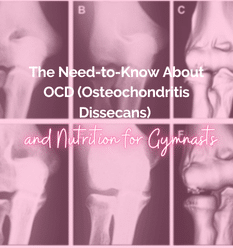
The Need-to-Know About OCD (Osteochondritis Dissecans) and Nutrition for Gymnasts – Episode 175
explore the blog
free training

The Podcast
Learn to fuel the gymnast for optimal performance and longevity in the sport.
How to Fuel the Gymnast
Learn how to fuel your gymnast so that you can avoid the top 3 major nutrition mistakes that keep most gymnasts stuck, struggling, and injured.
looking for...?
What Is OCD (Osteochondritis Dissecans)?
The dreaded “OCD”… a diagnosis no gymnast or parent ever wants to hear.
Osteochondritis dissecans (OCD) is a joint condition that occurs when a small section of bone beneath the cartilage becomes injured. This often happens from repetitive impact and restricted blood flow—two things gymnasts experience constantly. Without proper healing, that section of bone can weaken, die (necrosis), and even break loose. Sometimes, surgery is needed to repair or remove the fragment and even patch the hole with a bone graft from somewhere else in the body.
Common symptoms include:
- Pain, swelling, or stiffness in the affected joint
- Clicking, catching, or locking sensation
- Reduced range of motion or “giving out” during skills
For gymnasts, OCD most often develops in the elbows, knees, or ankles. Joints that endure thousands of load cycles every week from tumbling, vaulting, bars, and landings. It’s most frequently diagnosed in pre-teens and teens who are still growing.
Why Gymnasts Are at Higher Risk
Gymnastics is one of the most demanding youth sports on developing bones and joints. Athletes often train 20–30+ hours per week. And start before puberty, during a critical window of bone growth.
The condition often begins subtly: a small ache in the elbow or knee, stiffness after practice. Or pain that worsens during skills like kips, giants, or tumbling passes.
While coaches and parents often attribute these issues to “overuse,” OCD is more complex. It’s caused by repetitive micro-trauma to the bone beneath the cartilage, combined with impaired healing and blood supply. Over time, that section of bone can lose vitality, compromising the cartilage above it.
How This Happens in Gymnasts
In the elbow, repeated impact from weight-bearing on the arms—think handstands, vaults, and bar skills—creates compressive stress between the radius and the capitellum.
When it comes to the knee, repetitive jumping and landings cause shearing forces across the femoral condyles.
And in the ankle, the constant pointing, landing, and twisting under load can compromise bone circulation.
When the body can’t keep up with repair—whether from overtraining, underfueling, or both—the micro-injuries accumulate until a visible lesion forms.
🧠 The Chicken-or-Egg Problem: Overtraining or Underfueling?
Parents often ask: “Is this because my gymnast trains too much, or because she wasn’t eating enough?”
The answer is usually both.
At The Gymnast Nutritionist®, every gymnast we’ve worked with who developed OCD shared three common factors:
- High training hours (20–30+ weekly; sometimes seen when “only” training 12-15 hours weekly if nutrition is severely compromised)
- Unintentional underfueling (not eating enough to match energy demands)
- Growth deceleration—a slowing or plateau on growth charts in the 1–3 years leading up to diagnosis
Even small drops on the growth chart—say, from the 25th to the 10th percentile—signal that the body has been in an energy deficit. Pediatricians may dismiss this as “small but normal,” yet in athletes, it’s often the first red flag that the body doesn’t have enough fuel to grow, adapt, and repair.
We have gymnasts of all shapes and sizes that are impacted by joint OCD. And, the most common factor is poor growth due to years of underfueling.
How Underfueling Affects Bone Health
When a gymnast consistently underfuels:
- The body prioritizes what nutrition (calories) it does have for essential functions (brain, heart) and down-regulates repair + recovery.
- Hormones like IGF-1, estrogen, T3, and leptin decrease, reducing bone growth and turnover.
- Bone cells (osteoblasts) slow their activity, leaving the skeleton weaker and less resilient.
- Micro-fractures can’t repair properly—especially in cartilage-heavy joints.
This state of low energy availability (a hallmark of REDs, or Relative Energy Deficiency in Sport) sets the stage for injuries like OCD, stress fractures, and growth-plate disruptions.
🩹 Diagnosis and Medical Management
How OCD Is Diagnosed
If a gymnast has joint pain that lingers for more than a week or two—especially with swelling, popping, or limited motion—imaging is essential.
X-rays – Often the first diagnostic step, showing subchondral bone irregularities, lucency (areas of bone loss), or fragments.
MRI – The gold standard. MRI shows the size, stability, and blood flow of the lesion. It can identify whether the cartilage is still intact or separating.
CT or Ultrasound – Occasionally used for surgical planning or when MRI findings are unclear.
OCD lesions are graded from stable (healing potential) to unstable (requires surgical repair).
Treatment Overview: Conservative vs. Surgical
Stable OCD Lesions → Typically managed conservatively (rest, modified activity, bracing, nutrition, and gradual rehab).
Unstable OCD Lesions → Usually require surgical fixation, drilling, or grafting to restore bone-cartilage integrity.
Common surgical options include:
• Drilling or microfracture: creates channels to restore blood flow and stimulate fibrocartilage repair.
• Fixation: uses screws or pins to reattach a viable bone-cartilage fragment.
• Osteochondral grafting (OATS) or, in select cases, cartilage restoration (ACI): replaces nonviable bone-cartilage tissue in large or chronic lesions.
Even after surgery, full recovery and return to gymnastics can take 6–12 months or more, depending on the lesion’s severity and the athlete’s growth stage (and from what we’ve seen clinically, how good their nutrition status was prior to surgery- aka adequacy of fueling).
🧘♀️Conservative (Non-Surgical) Management
For growing gymnasts with stable lesions, a conservative approach is usually the first step.
Typical components include:
- Activity modification: removing weight-bearing or impact skills, sometimes bracing.
- Rest and rehabilitation: gradual mobility, strength, and neuromuscular training.
- Nutritional optimization: ensuring adequate calories, protein, and micronutrients to promote healing.
- Monitoring with repeat MRI or X-rays: to confirm revascularization and healing progress.
Healing can take anywhere from 3 to 6+ months, but success depends heavily on the gymnast’s fueling and recovery status—not just rest.
The biggest mistake gymnasts + parents make at this stage is not taking advantage of the 3 months off gym to catch up growth/development as quickly as possible through adequate nutrition intake. In our opinion, every single gymnast (or other athlete) diagnosed with joint OCD should immediately be referred to a pediatric/adolescent sports dietitian so that no time is wasted in optimizing nutrition while they are off activity.
We have seen a lot of gymnasts “fail” this 3 month conservative treatment because they remained underfueled and the body struggled to repair/recover without sufficient nutrition despite the time off.
⚠️ Why Conservative Care Sometimes Fails
Published studies report healing success rates from 40% to 87% for conservative OCD treatment. That wide gap often reflects differences in nutrition and recovery status, not just lesion size.
Many gymnasts don’t heal fully under conservative care because their bodies remain in a nutritional deficit even during rest.
Common factors behind stalled healing:
- Low overall caloric intake (underfueling) → inadequate energy for bone remodeling
- Inadequate carbohydrate availability (even if eating enough calorically) → increased inflammation that demineralizes the bones and compromises muscle acquisition
- Low IGF-1 and estrogen/testosterone (from underfueling) → impaired collagen synthesis
- Skipping meals → persistent cortisol elevation and inflammation
- Low magnesium and vitamin D intake → poor mineralization
- Low copper and ceruloplasmin → weak collagen cross-linking and poor iron transport
Even with strict rest, these athletes stay in a catabolic (breakdown) state. That’s why we say:
“Rest without nutrition = stalled healing.”
At The Gymnast Nutritionist®, we frequently see gymnasts who “did everything right”—rest, PT, braces—but still didn’t heal until fueling was corrected. Once caloric intake and minerals were optimized, repeat MRIs showed bone reformation within months.
🥗 The Nutrition Connection: Why Fueling Determines Healing
Energy Availability = The Foundation
Energy availability (EA) is the energy left for growth and repair after training demands are met.
When gymnasts underfuel, the body simply doesn’t have enough resources to grow, repair, and train simultaneously.
Most all the gymnasts we’ve worked with who are diagnosed with joint OCD have been meeting <50-75% of their estimated calorie needs for years and their growth has faltered because of this. They are often consuming <1500 calories a day while training 15-20+ hours per week and it’s just not sufficient for normal growth/development, repair/recovery, and adaptation to training (aka, the get better-faster-stronger part).
Signs of Low EA in Gymnasts:
- Slowed or plateaued growth, delayed development
- Fatigue or poor recovery
- Increased injuries (stress fractures, OCD, tendon pain)
- Missing or delayed periods in teen girls
- Mood swings, anxiety, or poor focus
During recovery from OCD, energy needs are often higher than during training because tissue repair is metabolically expensive. Healing can increase resting metabolic rate by 20–25%, even without full activity. We teach families that “eating like it’s a rest day” is one of the biggest healing mistakes. The body needs fuel to rebuild bone.
It is not uncommon for our gymnasts to easily need 2500-3000 calories per day while not participating at gymnastics to catch up on years of missed growth/development and healing.
Within-Day Energy Balance: Timing Matters
Even if a gymnast meets her total calorie goal by the end of the day, long stretches without food (like skipping breakfast or going 6 hours between meals) can keep the body in an energy-deprived state.
This “within-day balance” keeps blood sugar stable, reduces cortisol, and promotes anabolic (building) processes.
Growth Faltering = Bone Faltering
One of the earliest indicators of chronic underfueling is slowed growth.
When we review growth charts, most gymnasts who develop OCD show a downward shift in height or weight percentiles 1–3 years before diagnosis. Even small percentile drops—often brushed off as “she’s just petite”—reflect negative energy balance.
Low energy availability halts bone elongation and disrupts cartilage formation at growth plates, increasing the risk of injuries like OCD and stress fractures.
If your gymnast’s height or weight percentile has dropped or flatlined, that’s not “normal smallness”—it’s a red flag.
Carbohydrates: The Most Underrated Bone Nutrient
Carbohydrates are essential for bone health because they lower inflammation, reduce cortisol, and provide the glucose needed for collagen synthesis.
Low-carb or “clean eating” patterns (common among gymnasts) increase stress hormone production, which can accelerate bone loss and slow repair.
We work with a lot of gymnasts whose families often have protein/vegetable only meals. Parents can do whatever they want with their own nutrition but a gymnasts diet needs to be at least 50-60% carbohydrate which means a solid carbohydrate (grain/starch) source at every meal and most snacks.
When in doubt: Fuel the work you’re asking the body to do.
Protein: Repairing Muscle, Collagen, and Bone Matrix
Protein provides the amino acids for collagen and bone tissue repair. But protein alone can’t do the job without sufficient calories and carbs.
Optimal intake: 1.5-1.7g/kg/day, divided across 4–5 meals/snacks.
Include vitamin C (smoothies, citrus, berries) alongside protein to promote collagen formation.
The biggest mistake we see gymnasts and parents make with this is just pounding the protein without respect to adequacy of overall fueling. Consuming 30g protein shakes pre/post workout won’t save your gymnast if they are still in a caloric deficit.
It’s actually rare for us to have a gymnast not get enough protein since there is such a societal focus on this macronutrient. Often they aren’t getting protein evenly distributed throughout the day but more often they’re just not eating enough overall so not amount of protein is going to help.
Bone Nutrients and Mineral Cofactors 🧩
Calcium + Vitamin D
Critical for bone mineralization, yet most gymnasts with OCD have suboptimal vitamin D levels.
Target >40 ng/mL serum 25(OH)D. PSources: dairy, fortified milk alternatives, leafy greens, and sunlight exposure.
☀️ Why Vitamin D Isn’t a Silver Bullet
Vitamin D is important—but it’s not the full story.
Recent pediatric-athlete studies link vitamin D deficiency to stress fractures, RED-S, and Juvenile OCD (JOCD), but low D is typically a symptom, not the sole cause.
Vitamin D is often insufficient due to inadequate magnesium (either due to lack of oral intake or really high levels of stress on the body causing it to “burn” through magnesium five times faster than normal).
Frameworks like Morley Robbins’ Root Cause Protocol (RCP) emphasize that vitamin D can’t function properly without its mineral cofactors:
- Magnesium (RBC): activates vitamin D in the liver and kidneys
- Copper + Ceruloplasmin: essential for collagen cross-linking and iron transport
- Vitamin A (Retinol): balances vitamin D activity at the receptor level
- Zinc: aids cell replication and immune repair
Supplementing high-dose vitamin D without addressing cofactors can cause imbalances—raising blood calcium (and displacing it into the soft tissues and joints where it doesn’t belong) while failing to rebuild bone structure.
At The Gymnast Nutritionist®, we always “test, not guess.” We evaluate vitamin D, magnesium (RBC), copper, ceruloplasmin, retinol, and zinc to ensure the full system of bone metabolism is supported. Massive doses of vitamin D when not needed will deplete ceruloplasmin, potassium, retinal vitamin A, and magnesium—which are all essential cofactors for bone healing.
No gymnast should be put on a repletion dose (2000IU-5000IU+ vitamin D3) of vitamin D before labs have been checked. And, if vitamin D levels are already 35-40 ng/mL, more is not more (and can do more harm than good).
Managing Inflammation Without Restriction 🌈
Inflammation is part of healing—but chronic inflammation from underfueling, dehydration, or low-carb diets slows repair. The biggest source of inflammation for most competitive gymnasts is not what they eat, but underfueling (aka, malnutrition).
There is a time and place for anti-inflammatory supplements and strategies, but most gymnasts have no business with these because their foundational fueling is still so compromised.
Supportive strategies:
- Omega-3 fats: salmon, sardines, walnuts, fish oil
- Colorful produce: antioxidants and polyphenols
- Adequate carbs: prevent cortisol-driven bone resorption
- Avoid unnecessary restriction of entire food groups (e.g., “cutting sugar or dairy”) without medical cause (there is no research that shows dairy is inflammatory—massive meta-analysis studies have actually shown dairy has anti-inflammatory benefits in children and adolescents).
Fueling Through Surgery or Rehab 🏥
If your gymnast requires surgery for OCD, recovery nutrition is just as important as the operation itself.
Pre-surgery: huge focus on optimizing caloric intake for sufficient growth/development (catch up if needed) + ongoing healing. This is more important than anything else you are going to do or focus on. Then we can focus on adequate protein, consider supplements like collagen/creatine, and for us definitely deep-dive into labs + mineral analysis as well (learn more here). Surgical outcomes are not good in malnourished individuals, so we also recommended delaying surgery to allow for some time to optimize nutrition for the best surgical and return to sport outcomes.
Post-surgery: even if training load drops, energy needs remain high for repair. Most of the gymnasts we work with need MORE Nutrition post-surgery, not less, because they are in a massive caloric deficit from years of underfueling, aka malnutrition.
Fueling while recovering
Fueling “less” during rest delays recovery. Healing itself raises metabolic needs by up to 25% and then most gymnasts need way more than that. It is not uncommon for our gymnasts to need 3000 calories per day while healing from surgery even if unable to do anything in the gym or physical therapy for a while.
We have gymnasts who often do surgery with ROCKET doctors who specialize in this condition. It’s critical you use a surgeon who is very experienced with this condition since there is still a lot of ongoing research trying to determine best practices. Do not be afraid to get a second opinion and you might need to fly/drive across the country to someone like CA, MA, CT, TX for proper diagnosis and treatment.
It is then critical you work with a gymnastics-specific physical therapy who understands how to rehab and athlete back from these surgeries. Two of our favorites who are very well-versed are Dr. Ian Crider, DPT and Dr. Dave Tilley, DPT.
Return to Sport—What you must know
Whether your gymnast does conservative or surgical treatment for OCD, it’s critical their physical therapists and orthopedists consider their starting nutrition status when allowing them to return to sport.
There are very few protocols out there that can guide clinicians on how to progress a gymnast back to full sport participation. But, in a gymnast whose body is compromised due to years of underfueling (which is every single gymnast we’ve ever worked with who has had joint OCD)—you cannot progress them back as quickly as you’d expect.
Their bones, cartilage, tendons, etc are still compromised from years of underfueling (malnutrition) and following traditional return to sport timelines may be too quick for their bodies to handle and results in suboptimal healing + stalled progression.
We work with a lot of gymnastics specific physical therapists who will tell us they have gymnasts that are just not responding well to the rehab protocol, not because the gymnast isn’t compliant, but because it’s clear they are still undernourished and the body cannot repair and rebuild.
💬 Parent & Coach Takeaways
✅ If growth slows—fuel more, don’t train harder. OCD often presents after years of unintentional underfueling (often starting in levels 4-6 and continuing through levels 7-10/elite).
✅ Pain that persists for more than a week or two should be evaluated by a qualified orthopedist with imaging a prompt referral to a pediatric/adolescent sports dietitian.
✅ Bone injuries in gymnasts are rarely just a training problem—they’re almost always a fueling problem.
✅ Prevention through energy adequacy is far easier (and cheaper) than surgical repair.
🧩 The Bottom Line
OCD isn’t just a bone injury—it’s the body’s way of saying, “I don’t have enough resources to keep up.”
Healing requires more than rest and rehab. It requires adequate calories, balanced macronutrients, mineral sufficiency, and hormonal recovery.
At The Gymnast Nutritionist®, we help competitive gymnasts recover from underfueling, heal stronger, and perform better—through personalized, lab-based fueling strategies designed to support growth, bone health, and elite performance.
💬 Click here to learn more about how we work 1:1 with gymnasts through The Balanced Gymnast® 1:1 Program — designed exclusively for gymnasts recovering from injury, rebuilding confidence, and fueling for long-term success.
❓ FAQs About OCD (Osteochondritis Dissecans) in Gymnasts
What causes elbow OCD in gymnasts?
Repetitive impact on growing joints damages the cartilage and subchondral bone when blood flow is restricted or micro-trauma accumulates. The area weakens, leading to pain, swelling, or loose fragments that may require surgery.
Can nutrition really help OCD heal faster?
Yes. Bone and cartilage are metabolically active. Healing depends on energy, protein, and mineral availability. Underfueling slows every stage of the repair process—even with rest and PT.
Is vitamin D deficiency linked to OCD?
Recent studies show vitamin D deficiency is common in pediatric athletes with JOCD and stress fractures. However, D alone isn’t a cure—it needs magnesium, copper, and retinol to function.
How long does it take a gymnast to recover from OCD?
Stable lesions may heal in 3–6 months with rest and proper fueling; unstable lesions or surgeries may require 6–12 months or longer. Consistent nutrition and mineral support are key to preventing recurrence.
👩⚕️ About the Author
Christina Anderson, MS, RDN, CSSD, CSP is a board-certified pediatric and sports dietitian and founder of The Gymnast Nutritionist® and The Balanced Gymnast® programs. She helps competitive gymnasts and youth athletes recover from underfueling, optimize growth, and prevent overuse injuries like OCD and stress fractures. Her team collaborates with surgeons, physical therapists, and coaches nationwide to help gymnasts fuel for performance, confidence, and long-term health.
Connect on Instagram @the.gymnast.nutritionist or visit thegymnastnutritionist.com
on the blog